“The goal is to change institutional behavior.” Experts dissect the unlawful Dept. of Ed Feb. 2025 Dear Colleague Letter
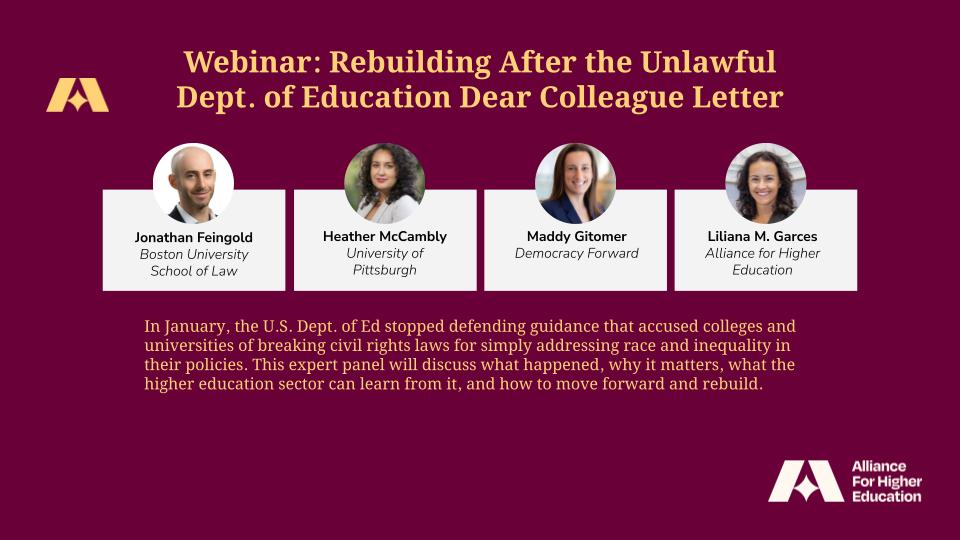
There is a tendency in our societal discourse to treat legal rulings as the final word. We assume that if a policy is found unconstitutional, the system simply reverts to its previous state. But as a recent webinar hosted by the Alliance for Higher Education—attended by more than 150 leaders, practitioners, scholars, and higher ed supporters—made clear, that is rarely an outcome when a sector is under attack. There is the policy and then there is the public narrative around its potential impact and ramifications. Oftentimes, institutions shift their operations long before any changes are necessary, or overcorrect out of fear of retribution.
Last month, the U.S. Department of Education dropped its appeal of a lower court ruling that had struck down a controversial 2025 "Dear Colleague" letter (DCL). On paper, this is a victory for academic freedom, intellectual rigor, and democracy that refutes the false claim that work to advance equity hinders quality and excellence. The court found that the government’s attempt to use Title VI to chill discussions of systemic racism was unlawful.
The power of the 2025 guidance wasn’t in its legal durability, but in its ability to paralyze. Maddy Gitomer, who led the challenge to the DCL as senior counsel at Democracy Forward, described it as a weaponized misinterpretation of law: "The letter was not a guidance or reminder document... it weaponized civil rights laws, it really misread, misinterpreted them and added many or tried to add many new requirements for schools."
This creates a phenomenon panelist Heather McCambly, a professor at the University of Pittsburgh School of Education, called "repressive legalism"—the use of tenuous legal directives to generate a broad chilling effect . She noted how this strategy bypasses the courts entirely: "The goal is not necessarily to prevail judicially. The goal is to change institutional behavior right away through fear and fragmentation."
The term, “repressive legalism” is a product of research from panel moderator Liliana M. Garces, Vice President of Research and Impact for the Alliance, and names a phenomenon that was on display over the past year in relation to this DCL: the scaling back of efforts that promote equity and belonging not because of the law itself, but because of fear of ongoing threats from the legal environment. This dynamic keeps institutions from restoring policies even after the policies are declared unlawful and unconstitutional like in this case.
The Cost of Neutrality
When institutions stay silent to avoid political heat, they aren't actually remaining neutral. They are allowing a new regressive logic to become the common sense of the sector, said Jonathan Feingold, professor of law and Boston University. "I was naive a year ago. My expectation was that if university leaders understood the law and could have comfort that the common practices, policies, and programs that they employed that were designed to promote a more diverse, equitable, and inclusive campus were lawful, they would protect them.”
In retrospect, a year later, he says, “I was very wrong.”
By allowing equity work to be falsely reframed as a threat to quality, universities risk losing their core purpose. Supporting the premise, McCambly added that "If commitments to doing equitable work in our communities can be isolated and framed as optional or suspect, they're vulnerable to exactly this kind of pressure."
An Architecture of Solidarity
While the first half of the discussion was an autopsy of institutional fear, the conversation concluded with a blueprint for optimism. The panelists argued that while the legal victory is significant, the true opportunity lies in how the higher education sector chooses to show collective support and alignment in the future.
Gitomer pointed to the sheer speed and breadth of the legal pushback as a proof of concept for collective action. "I was really struck... by the courage and passion of our clients in this case," she noted, citing how unions and professional associations stood together before they even knew how the courts would rule. This represents a shift from individual institutional "risk management" to a shared "architecture of solidarity." The hope lies in the realization that universities do not have to wait for the courts to save them. They can build their own defenses.
McCambly highlighted that scholars can play a vital role in "interrupting the narrative before it hardens into policy" by offering research-informed counter-stories about why inclusive education is, in fact, the public good.
Ultimately, the experts suggest that the crisis of the last year has surfaced a latent strength in the sector. By choosing to defend people and principles rather than just budgets, higher education has the chance to reclaim its role in a multiracial democracy. As Feingold reminded the audience, the goal is to make sure universities remain a place for the "rigorous pursuit of knowledge for the common good"—a mission only possible when institutions and organizations stand together.