
Experts Warn Political Interference in Accreditation Threatens Professional Expertise and Democratic Governance
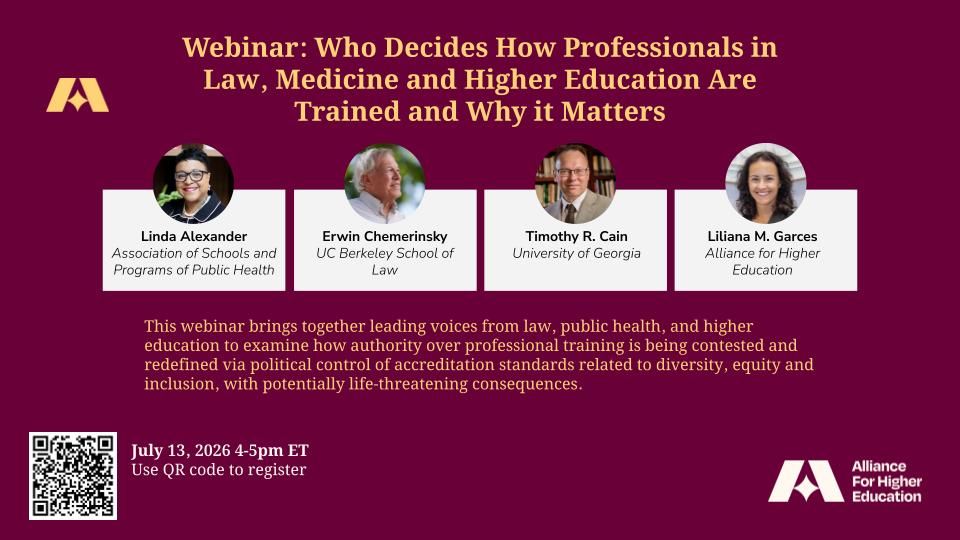
The Alliance for Higher Education hosted a panel of experts in higher education policy, law, and public health, titled “Who Decides How Professionals in Law, Public Health and Higher Education Are Trained and Why it Matters.” Through a robust discussion, panelists explored how political intervention is reshaping accreditation standards across these sectors, particularly through changes to diversity, equity, and inclusion standards.
While specific changes to accreditation differ by sector, speakers agreed that these efforts reflect the administration’s broader attempt to transfer authority over professional standards from experts and educators to political actors, with significant consequences for professional training, public trust, and democratic governance.
If you weren’t able to make the webinar, you can view the recording here or read through the recap below.
Why Accreditation Matters
Accreditation is far more than a bureaucratic process. Panelists opened the webinar with an acknowledgement and emphasis on accreditation's purpose: to serve as a system of professional self-governance through which experts establish standards for educational quality, ethical practice, and professional preparation.
Dr. Linda Alexander, Chief Academic Officer of the Association of Schools and Programs of Public Health (ASPPH), compared accreditation to the standards that govern aviation, infrastructure, and other professions where public trust depends on expert oversight. Alexander emphasized accreditation’s purpose as, “the industry standard for higher education."
For generations, accreditation has functioned through peer review and professional expertise rather than direct political control. Panelists agreed this independence is a crucial way for the sector to ensure educational and professional standards remain grounded in evidence and disciplinary knowledge, rather than partisan agendas.
Public Health: What's at Stake for Communities
Alexander framed the issue of accreditation as a question of health outcomes and professional ethics, pointing to the need to prepare future professions to understand the factors that shape health outcomes – from access to care, environmental exposures, geography, public policy and bias within healthcare systems. She pointed to extensive evidence linking inequities in treatment and access to persistent disparities in health outcomes, including maternal mortality, chronic disease, and preventable illness. In short: removing discussions of equity and bias from professional training risks leaving future health professionals less prepared to address these realities.
"We are discussing the potential of erasure of years of scientific and unbiased evidence that dictates the necessity of training in equity and bias as a part of public health, medicine and other professional training," – Dr. Linda Alexander
What’s at Stake for Legal Education
Dean Erwin Chemerinsky of the University of California, Berkeley School of Law explained how accreditation shapes legal education through the American Bar Association (ABA), the accrediting body whose standards determine how future lawyers are trained.
Chemerinsky highlighted recent state actions to reduce reliance on the American Bar Association's role in legal education oversight, including decisions by Texas and Florida to allow graduates of law schools accredited through alternative pathways to pursue bar admission. Chemerinsky also expressed concern about the ABA's decision to repeal Standard 206, which encouraged law schools to pursue diversity and inclusion, and the proposals to eliminate accreditation requirements that law schools provide instruction on bias, racism, and cross-cultural competency.
According to Chemerinsky, accreditation standards reflected the reality that "We, as a profession, should be preparing our students to deal with the diverse world in which they are going to practice as lawyers." With many institutions adopting new educational practices in response to accreditation requirements, he warned some schools may now eliminate the pursuit of diversity and inclusion altogether, drastically reducing opportunities for law students to gain critical professional competencies.
Higher Education Accreditation
Professor Timothy Cain of the University of Georgia connected the dots between the latest developments to accreditation and the broader changes the sector is seeing across the sector.
For nearly 150 years, he explained, accreditation has served as a system through which institutions collectively establish standards for educational quality and accountability. Today, however, federal and state policymakers are increasingly seeking to exert greater influence over the accreditation processes. Cain pointed to a host of efforts, including the creation of new accrediting bodies, weakening existing accreditor authority, eliminating diversity-related standards, and changes to the negotiated rulemaking process.
"The control of the college curriculum, which has traditionally been in the hands of experts, being taken out of the hands of experts creates all sorts of problems for the future of society," – Timothy Cain
What's at Stake for Democracy
Ultimately, the debate surrounding accreditation is a debate about democracy and public well-being. Accrediting bodies, universities, law schools, and public health programs all serve important democratic functions. They generate knowledge, prepare professionals, and ensure that expertise remains accountable to evidence and the full diversity of lived experiences in a multiracial democracy.
Because equity reflects long-standing constitutional principles of equal treatment, Chemerinsky stressed the importance of equity and inclusion, as longstanding constitutional principles of equal treatment, remaining a central goal of educational institutions.
Emphasizing that the proposed changes to accreditation are a fundamental threat to democracy, Cain noted, “Our institutions should be open to and welcoming to all. Using accreditation to try to make them less welcoming to members of underrepresented groups might fit a partisan agenda, but makes the experiences of those in higher education worse, and does harm to the country.”
The Path Forward: Collective Action
Panelists closed the session by encouraging meaningful opportunities for action, calling on educators, students, professional associations, and those outside the higher ed sector to learn about the active threats to accreditation and what’s at risk.
Chemerinsky emphasized the importance of a “unified reaction,” with “people across disciplines expressing that this is unacceptable, that we want to have universities accredited on the basis of professional standards, not political ones.”
Maintaining the independence of accrediting bodies is essential to preserving public trust, professional competence, and the capacity of institutions to serve a multiracial democracy. With unified actions across the sector, we can make our voices heard and advocate for accreditation standards grounded in evidence and expertise.
We anticipate the public comment period for accreditation will open soon. The Alliance is ready to comment and is preparing materials to garner support. Make sure you are following us on LinkedIn and subscribe to our newsletter to hear the latest and make your voices heard.
Read More
View All Resources
State and federal policy decisions are restricting educational opportunity in higher education
Academic Freedom Is Winning in Court. Institutional Behavior Should Follow.
Experts Warn Political Interference in Accreditation Threatens Professional Expertise and Democratic Governance
Higher Education Advocates Call for Unity in Response to the Department of Education’s Disingenuous “National Call to Action”
Alliance Fellow Dominique Baker: Reducing the Concentration of Power
Public Comment Regarding OMB's Rule Proposal to Require Political Approval of Federal Awards
System for Award Management Proposed Rule Public Comment and Sign-on Letter
Alliance President and CEO Mike Gavin's Advice for Rebuilding Trust in Higher Ed
Under Pressure: What’s Keeping Presidents Up at Night in 2026
Civic Learning and Democracy Engagement Coalition Webinar and Guide for Generative Curriculum Planning
Commentary: How Colleges Extend the Reach of Anti-DEI Laws
Alliance President and CEO Statement: Conclusion of AIM Committee and Dept of Ed Negotiated Rulemaking Meetings
AIM Committee Negotiated Rulemaking: Faculty and Association Statements on Academic Freedom and Intellectual Diversity
THE RANT podcast with Eloy Ortiz Oakley: Accreditation Under Fire with Mike Gavin
Commentary: When Targeting DEI Means Restricting Research and Academics
Q and A with Alliance President Mike Gavin: Seeking Strength in Numbers
President Mike Gavin and VP Liliana M. Garces join Student Affairs Now Podcast
Inside Higher Ed's editor-in-chief explores 'NATO for universities' in column
Podcast: Key findings from Inside Higher Ed’s 2026 survey of college and university presidents
The fifth pillar of democracy: Is it time for a ‘NATO for higher education’?
‘Authority Over Expertise’: Scholars Spotlight Political Takeover of General Education in Alliance Webinar
New Accreditation Rules Could Open ‘Can of Worms’ in Higher Ed, Experts Say
New Alliance for Higher Education Fellowship Program, Fellows, Seek to Advance Higher Education as Fifth Pillar of Democracy
Principled Leadership to Advance Public Trust in Higher Education
Alliance President and CEO Mike Gavin in Inside Higher Ed: Weaponization of Student Aid Is the Next Frontier
Alliance President grades ED letter to Middle States asserting illegal DEI, finds lack of legal foundation
Higher education experts outline impending threat: the weaponization of accreditation, federal student aid
EDU Ledger Features the Alliance’s Mission to Protect the "Fifth Pillar of Democracy"
American higher education shines on Winter Olympics’ global stage
“The goal is to change institutional behavior.” Experts dissect the unlawful Dept. of Ed Feb. 2025 Dear Colleague Letter
Letter to Oklahoma State Regents for Higher Education in Opposition of Executive Order 2026-07
Daily Briefing: A response to Project 2025?
Hitting Pause on the ‘Dear Colleague’ Letter
36 Organizational Partners, Call on Texas A&M to Rescind Censorship Policies
New Alliance Aims to Protect Colleges and Universities From Government Meddling