
Academic Freedom Is Winning in Court. Institutional Behavior Should Follow.
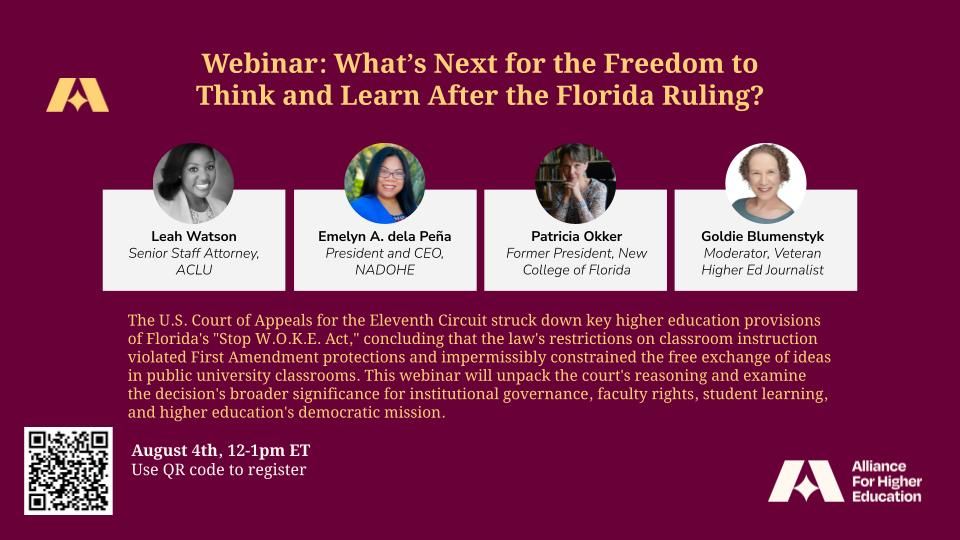
In the wake of the federal appeals court decision striking down key provisions of Florida's "Stop WOKE Act," the Alliance for Higher Education convened legal experts and higher education leaders to assess “What’s Next for the Freedom to Think and Learn.” As panelists revisited the origins and consequences of the law, a larger theme emerged: The legal tide is turning in favor of academic freedom, but the ultimate outcome will depend on whether colleges and universities allow those victories to inform institutional behavior.
If you weren’t able to attend the webinar, you can view the recording here or read the recap provided below.
The Eleventh Circuit Rejected Political Efforts to Control Teaching and Learning
ACLU Senior Staff Attorney and lead counsel on the case, Leah Watson, traced Florida's "Stop WOKE Act" to the post-2020 conservative backlash against racial justice initiatives, beginning with a Trump executive order and continuing through state legislation after Trump left office. Enacted in 2022, the law's eight vaguely defined "divisive concepts" restricted discussions of race and sex across K-12 schools, higher education, and workplaces. As Watson explained, Florida's law rested on an extraordinary theory of state power: that because the state pays professors' salaries, it can dictate the content of classroom instruction.
The Eleventh Circuit decisively rejected that argument, reaffirming that classroom instruction is not government speech and that the First Amendment protects universities’ and professors’ right to make teaching choices without government censorship targeting disfavored viewpoints. Colleges and universities, the court noted, should be “centers of inquiry — classrooms where students are trusted to puzzle through ideas that are good and bad, easy and hard, ideally getting ever closer to the truth.”
The significance of the decision extends beyond Florida. It demonstrates that many of the legal theories used to justify restrictions on teaching and learning are far less persuasive in court than political rhetoric might suggest. As Watson noted near the conclusion of the webinar, "I have a lot of hope that we are winning when we are filing cases."
The Larger Problem Is Changes in Institutional Behavior Through Fear
Yet, panelists repeatedly returned to a more troubling question: while advocates of academic freedom succeed in the legal arena, institutions are still changing policies based on fear. Dr. Emelyn A. dela Peña, for example, noted that institutional overcompliance–going further than the law required–has often caused more damage than the laws themselves. In fact, across the country, colleges and universities have scaled back programs, dissolved offices, altered communications strategies, and narrowed educational offerings in ways that frequently exceed what the law requires.
This dynamic, which has been discussed in prior webinars, is one in which political actors change institutional behavior through fear rather than lawful policies, and it keeps institutions from restoring policies even after the policies are declared unconstitutional, like in this case. As Dr. LaPeña noted, much of the impacted infrastructure has not been rebuilt.
Legal Victories Alone Cannot Protect Academic Freedom
Panelists connected the "Stop WOKE Act" to recent federal actions, including the Department of Education's Dear Colleague Letter and other efforts designed to pressure institutions to alter their practices. Although these initiatives differ in form, they often operate through a similar mechanism: creating uncertainty, encouraging self-censorship, and prompting institutions to limit their own activities before courts have an opportunity to intervene. Florida has also passed follow-up legislation, including Senate Bill 266, restricting curricula and eliminating diversity roles.
The result is that contested policies can succeed in reshaping institutional behavior even when they fail judicial scrutiny. For these reasons, legal victories alone cannot fully protect academic freedom. Institutional leaders must also resist the impulse to interpret every political threat as a legal mandate. Dr. dela Peña urged university leaders to "Draw a clear boundary between what is an actual legal requirement and what is political noise" before taking any action, and encouraged institutions to hold onto their "anchor" — described as "the fundamental commitment to educational access, student success and the pursuit of truth and learning."
Goldie Blumenstyk, who moderated the discussion, summed up the dangers of these federal efforts saying: "Anticipatory compliance is dangerous, whereas standing up for what's right is not as dangerous." Watson agreed that fighting back has worked, but described the ongoing challenge with a relatable metaphor — "You must feel a little bit like you're playing a very high-stakes game of whack-a-mole here" — to which Watson simply replied, "Absolutely. For all of us."
Looking Ahead
Perhaps the most important lesson from the webinar was that higher education now possesses stronger legal footing for leaders to consider, but those victories matter only if institutions are willing to act on them.
Pat Okker suggested that the field must move beyond defensive postures and reconnect academic freedom to a broader public purpose: students' freedom to learn and pursue truth. Doing so requires more than litigation. It requires institutions to stop treating contested political demands as settled law and to rebuild what was unnecessarily dismantled during periods of uncertainty. Watson reinforced the power of centering students directly, noting that "Having students advocate for themselves is extremely powerful."
The Florida ruling therefore represents both a victory and a test. Similar cases are already underway in other circuits, including a recent lawsuit the American Association of University Professors initiated against the Texas Tech University System Chancellor and Board of Regents to address restrictions on what can be taught in classrooms about sex, race, gender identity and sexual orientation.
Blumenstyk praised organizations like the Alliance for giving institutions the resources and reassurance that "they're not alone out there." All three panelists agreed that this ruling offers a meaningful, tested foundation for defending the freedom to teach, learn and think moving forward.
Read More
View All Resources
State and federal policy decisions are restricting educational opportunity in higher education
Academic Freedom Is Winning in Court. Institutional Behavior Should Follow.
Experts Warn Political Interference in Accreditation Threatens Professional Expertise and Democratic Governance
Higher Education Advocates Call for Unity in Response to the Department of Education’s Disingenuous “National Call to Action”
Alliance Fellow Dominique Baker: Reducing the Concentration of Power
Public Comment Regarding OMB's Rule Proposal to Require Political Approval of Federal Awards
System for Award Management Proposed Rule Public Comment and Sign-on Letter
Alliance President and CEO Mike Gavin's Advice for Rebuilding Trust in Higher Ed
Under Pressure: What’s Keeping Presidents Up at Night in 2026
Civic Learning and Democracy Engagement Coalition Webinar and Guide for Generative Curriculum Planning
Commentary: How Colleges Extend the Reach of Anti-DEI Laws
Alliance President and CEO Statement: Conclusion of AIM Committee and Dept of Ed Negotiated Rulemaking Meetings
AIM Committee Negotiated Rulemaking: Faculty and Association Statements on Academic Freedom and Intellectual Diversity
THE RANT podcast with Eloy Ortiz Oakley: Accreditation Under Fire with Mike Gavin
Commentary: When Targeting DEI Means Restricting Research and Academics
Q and A with Alliance President Mike Gavin: Seeking Strength in Numbers
President Mike Gavin and VP Liliana M. Garces join Student Affairs Now Podcast
Inside Higher Ed's editor-in-chief explores 'NATO for universities' in column
Podcast: Key findings from Inside Higher Ed’s 2026 survey of college and university presidents
The fifth pillar of democracy: Is it time for a ‘NATO for higher education’?
‘Authority Over Expertise’: Scholars Spotlight Political Takeover of General Education in Alliance Webinar
New Accreditation Rules Could Open ‘Can of Worms’ in Higher Ed, Experts Say
New Alliance for Higher Education Fellowship Program, Fellows, Seek to Advance Higher Education as Fifth Pillar of Democracy
Principled Leadership to Advance Public Trust in Higher Education
Alliance President and CEO Mike Gavin in Inside Higher Ed: Weaponization of Student Aid Is the Next Frontier
Alliance President grades ED letter to Middle States asserting illegal DEI, finds lack of legal foundation
Higher education experts outline impending threat: the weaponization of accreditation, federal student aid
EDU Ledger Features the Alliance’s Mission to Protect the "Fifth Pillar of Democracy"
American higher education shines on Winter Olympics’ global stage
“The goal is to change institutional behavior.” Experts dissect the unlawful Dept. of Ed Feb. 2025 Dear Colleague Letter
Letter to Oklahoma State Regents for Higher Education in Opposition of Executive Order 2026-07
Daily Briefing: A response to Project 2025?
Hitting Pause on the ‘Dear Colleague’ Letter
36 Organizational Partners, Call on Texas A&M to Rescind Censorship Policies
New Alliance Aims to Protect Colleges and Universities From Government Meddling